
Partner Meetings - Freelancer Views - Naomi Obeng

Written June 2025
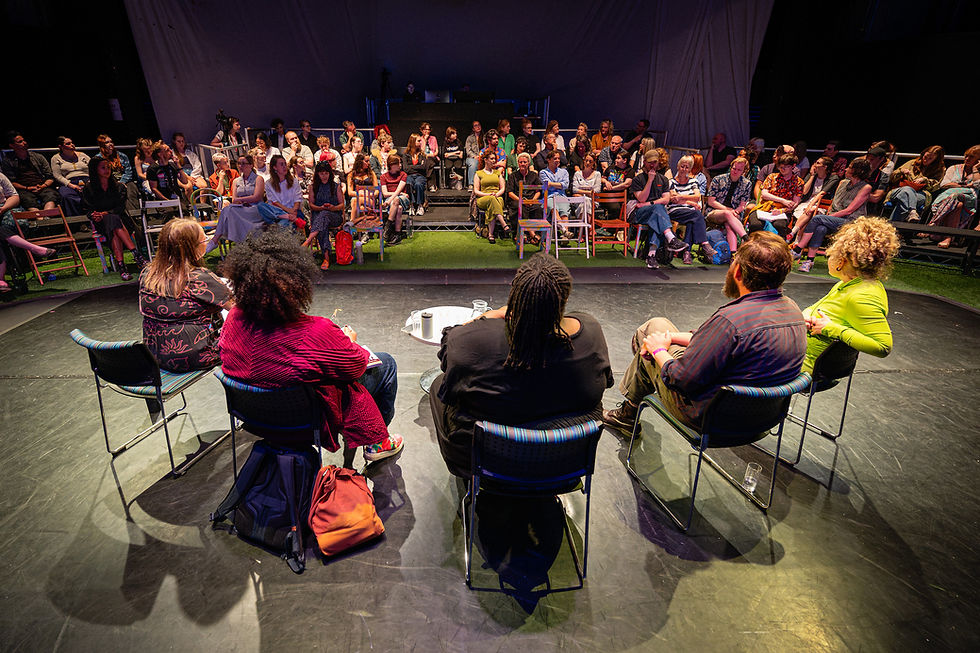
IGC invites a freelancer to sit in on meetings with partner venues. I was invited to attend the June Partner meeting, which featured updates from the partner venues on their artist development programmes, discussion on supporting and advocate for independent artists in this challenging arts funding landscape, and sharing of IGC’s new plans for the Take Off Writing Prize, for which writers in the region were consulted.
The partners in attendance were from Royal & Derngate, Nonsuch, Corby Cube, Derby Theatre, Nottingham Playhouse and Arena Wolverhampton.
Firstly it was heartening to hear the thought and effort going into artist development activities in the region. Each county has its own unique landscape and each are tackling artist development differently.
Wolverhampton is thinking around coordinating with Midlands Fringe for instance, and how to increase opportunities for development in collaboration with this burgeoning scene. Corby Cube’s collaboration with the Northampton Writers Development group is a way to help cater for the writers of the region, and an online session ‘What would you change about theatre, not just the money’ aimed to provide artists with an opportunity to imagine a better future together. Royal & Derngate’s continue their new associate artist scheme and their GenFest programming. They highlighted the difficulty in choosing only a few associates from the higher number they would like to help. Nottingham Playhouse’s Amplify network continues to build opportunities for artists to showcase new work. Similarly, Derby Theatre’s associate artists remain and of course their hosting of Departure Lounge Festival which gives a platform to artists across the Midlands.
The partners spoke of how tough it is to advise artists on how to get funding given the current success rates for Arts Council Applications (estimated at 25% at time of meeting)). They spoke about how there seems to be an assumption from ACE that the money given to venues will trickle down to artists – but with many venues in deficit working hard to produce shows without enough resources, this just isn’t the case. They also raised the unequal investment in the arts per population (£1.50 per head in Corby), which affects what can reasonably be achieved. IGC faces a ceiling on ACE resources on a technicality too, as activities supporting the Midlands as a whole don’t fit into ACE’s ‘city/town’ category, necessary for getting development funds over £100k. It all feels a bit grim.
Talk naturally then turned to advocacy and IGC’s desire to strengthen and pull together Midlands venues. The sense is to move from being experts at dividing up smaller and smaller pots of money, to figuring out and demanding what resource is actually needed to sustainably develop artists in the region. That makes sense to me. IGC made a parallel to WGGB’s advocacy, which aims to prioritise writers’ needs in ACE’s agenda (this also linked to Take Off Prize plans, more to come publicly).
I also was able to put in my two cents on the development of playwrights specifically in the region, since that’s my area of experience, and to be honest, dissatisfaction. The necessity to do as much as possible with less and less resource has an impact on our ability to understand and imagine what is really needed. I asked if the artist development representatives had their own sense of what development toward a production in their venue looks like for playwrights and whether they articulate this to playwrights within their ‘development’ of said playwrights…
For example, how does a working class young person with an inkling of an interest in theatre but no sense of a path, no support from dwindling arts education in school, go toward fulfilling their ultimate potential as a word class playwright? Is it thanks to venues or despite them? Do they get to write the stories on their own terms, in whatever form they see fit, or only the stories that can make a successful ACE-funded R&D? Do they access guidance and expertise? Do they have to leave the region to find a home? Will it only be writers from certain backgrounds making main stage?
I put forward, in a roundabout way, that you’d like the institutions you're talking to about your work to know more than you do about the rigours of taking new writing (non-devised playwriting) to the stage. If those plays so rarely get to the stage, then that won’t be the case. And if the work gets to the stage only via Artistic Direction-direct programming, then those in Artist Development won’t know any more than you do. A closed cycle without input or output is maddening.
If the region’s script development work is not linked up with any venue's artistic direction, then how can it be claimed as development? Development of what? Toward what? What is the investment actually doing for writers? It’s investment without purpose other than to say that investment has happened. Literary work is exacting. It is informed. It is empathetic. Connected to canon, or intelligently fighting it. It is long-term. It has a long tradition and it, at its best, works to secure against the access inequalities inherent in the work of playwriting, which always will and has required so much unpaid and private work, the fruits of which cannot be measured and sometimes are never directly read. Developing playwrights is different to developing theatre-makers and devisers.
I might be completely wrong. But I do know that transparency from venues helps with honesty about how things are, and honesty with artists about how things are is what IGC is all about – it’s proven to expose what isn’t adding up and to tackle it, again, which is what IGC does so well. I left the meeting pleased to know that there is such good and committed artist development work happening despite the challenges, but also convinced that there needs to be a clearly articulated acknowledgment of the situation for playwrights in the Midlands from venues. Venues who produce plays have a responsibility to make plain what they think is a perennial problem for playwrights (unsolvable) and what is an acute contemporary one (to be worked at). They have a responsibility to deeply reflect on what their resources (both financial and individual capacity – artist development ‘teams’ are very often one person with far far too much to manage) are doing for playwrights, and be transparent on whether they have an interest (regardless of available resource – you definitely can’t fund an unthought idea) in doing more to break the closed cycle and take a stake in developing the region’s writer voices in the long-term.

Comments